 Kinnetly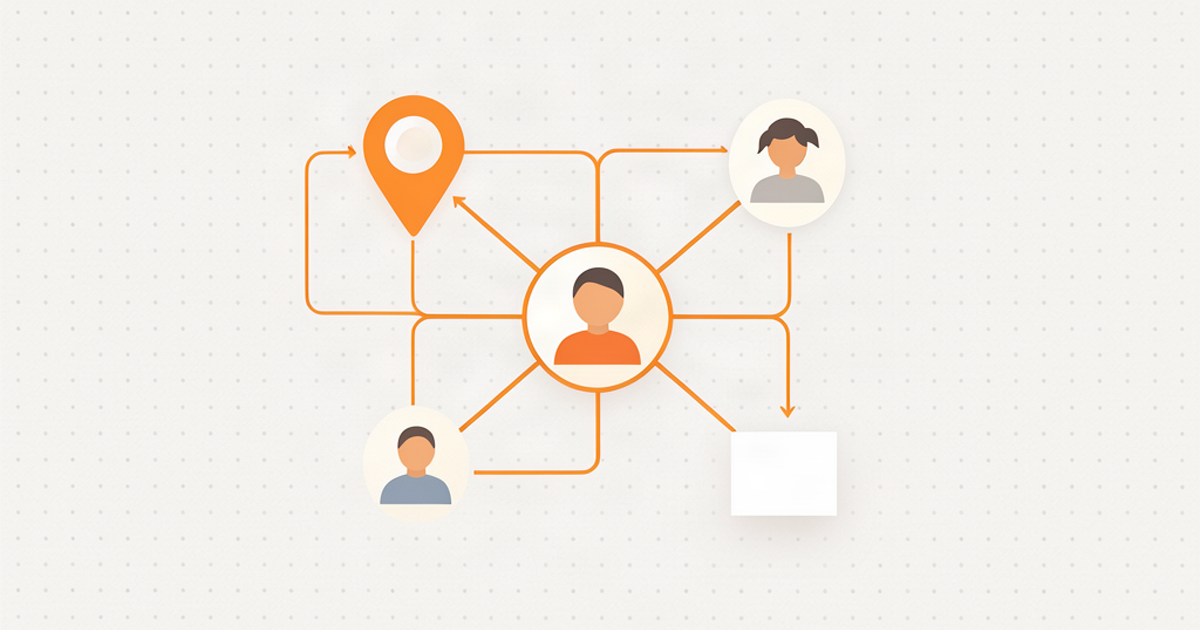
You can meet someone brilliant and still forget the useful part two weeks later.
Not because they were forgettable. Because memory is bad at storing small details when your week is full. You remember the face, maybe the company, maybe the general vibe. What disappears is the bit that makes a future message feel natural: where you met, who introduced you, and what you actually talked about.
If you want to remember where you met someone, do not rely on memory. Capture the context while it is still fresh, then make it easy to find later.
Why names are not enough
Most contact lists are built around names, phone numbers, and email addresses. That is fine for sending a message. It is not enough for maintaining a relationship.
The useful context is usually more human:
- We met at the Brisbane startup event.
- Mia introduced us after the panel.
- He was looking for a fractional CFO.
- She had just moved teams.
- We talked about hiring the first support person.
Those details are what make a follow-up feel personal instead of generic.
Compare these two messages:
Hi Alex, it was good meeting you recently. Keen to stay in touch.
And:
Hi Alex, I enjoyed our chat after the Brisbane AI meetup. I found the article I mentioned about onboarding first-time managers, thought you might like it.
The second one works because it carries the moment forward.
Capture the meeting point first
The first thing to record is where the relationship started.
That might be an event, a company, a group, a mutual friend, or a specific introduction. You do not need a perfect filing system. You just need enough detail to answer the question, "How do I know this person?"
Good meeting-point notes look like this:
- Met at Something Fest, after the investor panel
- Introduced by Priya from Acme
- Former colleague from the product team at Finch
- Parent from Saturday football
- Met through the Brisbane founders WhatsApp group
Short is fine. Specific is better than polished.
If you only write "conference", you will not remember much. If you write "Brisbane business breakfast, table near the back, conversation after the pricing talk", you have a real hook for later.
Record who introduced whom
Introductions deserve their own attention.
When someone introduces you, they are lending a little bit of trust. If you forget that path, you lose context that may matter later. You might forget to thank the introducer. You might ask the wrong person for a future introduction. You might miss that two people in your network are connected through the same small group.
At minimum, record:
- who introduced you
- who they introduced you to
- when it happened
- why the introduction was made
For example:
Priya introduced me to Sam in March after I asked about onboarding advice. Sam had scaled support at Acme.
That note is useful months later. It tells you why the relationship exists and gives you a natural reason to follow up.
Add one useful personal detail
You do not need to document someone's whole life. In fact, trying to record too much usually means you record nothing.
Pick one useful detail after each meaningful conversation. Something that would help you write a better message later.
It could be:
- a project they were working on
- a decision they were trying to make
- a person they wanted to meet
- a book, tool, or idea they mentioned
- a personal milestone they brought up naturally
Keep it respectful. The goal is not to build a dossier. It is to remember what they chose to share with you.
A good rule: if mentioning it later would make them feel remembered, keep it. If it would feel intrusive, leave it out.
Write the note before the day ends
The best time to capture context is immediately after the conversation. The second-best time is later that day.
After that, the details start blending together.
Use whatever habit fits your life:
- add a note while walking to the next meeting
- dictate a quick voice note after an event
- scan the business card before it ends up in a drawer
- set a reminder to follow up before you leave the venue
- write three bullet points when you get home
Do not wait until you have time to organise everything properly. That time rarely arrives.
The note can be rough. "Met Jo at River City Labs, talked about partner channels, send intro to Maya" is enough.
Link the person to the place
People are easier to remember when they are connected to something else.
A flat contact entry asks your brain to remember an isolated name. A relationship map gives the name a place: this person came from that event, through that friend, while you were talking about that problem.
That is why it helps to connect contacts to companies, events, groups, and introducers. Later, you can search your memory from several angles:
- Who did I meet at that conference?
- Who introduced me to Sam?
- Who do I know at Acme?
- Who was looking for help with hiring?
- Who did I promise to follow up with after that event?
Those are the questions real life asks. Your system should be able to answer them.
Use context to make the next message easier
Remembering where you met someone is not only about avoiding embarrassment. It makes the next message much easier to write.
A useful follow-up usually starts from shared context:
I was thinking about our conversation at the founders breakfast.
Priya mentioned you were looking at partner channels, and I came across something relevant.
We met after the panel last month. You mentioned you were comparing CRMs, so I thought I would send this through.
That kind of message does not feel forced. It has a reason to exist.
When you keep the context, staying in touch takes less effort. You are not starting from a blank page every time.
How Kinnetly helps
Kinnetly is built for this exact problem. It is a private relationship map, not just a contact list.
You can record people, companies, events, groups, introductions, notes, and follow-up reminders in one place. The map helps you see how people are connected, who introduced whom, and where each relationship started.
That matters because relationships rarely live in neat rows. They live in context.
If you want to see the difference between a contact list and a relationship map, have a look at how Kinnetly works. If you are coming back from an event with a pile of names, the free contact QR code generator and vCard/CSV converter can also help you get the basics captured quickly.
Make the note before the context disappears
The useful details do not disappear all at once. They blur.
At the end of a busy event, you may still remember the person clearly. A week later, you remember that you liked them, but not who introduced you or what you promised to send. That is the moment a future follow-up becomes harder than it needed to be.
So keep the habit small enough that you will actually do it.
After a useful conversation, capture one line before you move on:
Met Jordan at the Brisbane business breakfast. Priya introduced us. Talked about hiring first support person. Send onboarding article.
That line is not polished, but it is enough. It gives the relationship a place, a person, a topic, and a next step.
Do that consistently and your network stops being a pile of names. It becomes a set of stories you can return to when you need them.
Ready to map the people you know and how you met them? Get started with Kinnetly for free.