 Kinnetly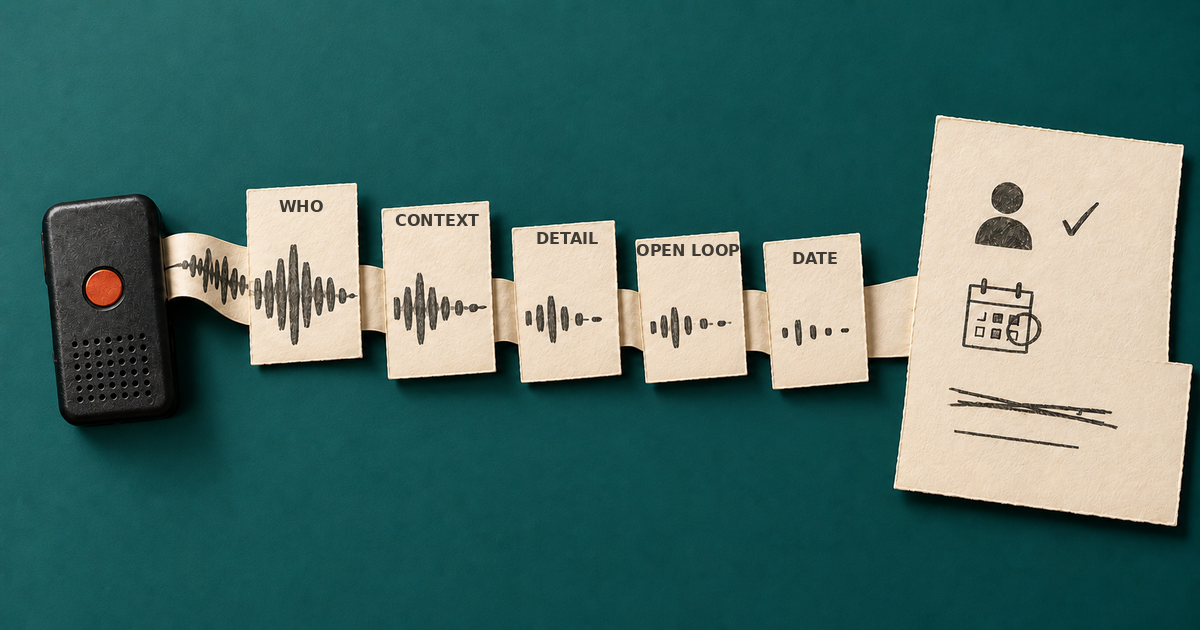
Voice notes for networking work best in the minute after a useful conversation, while the details are still close at hand. Record your own short recap, name the open loop and check the note before you save it. You don't need a full transcript. You need enough context to act with care later.
A simple prompt keeps the recap focused:
Who. Context. Useful detail. Open loop. Date.
That can take less time than writing a message you aren't ready to send.
Memory keeps the gist and drops the useful edges
After a good conversation, it's easy to think, "I'll remember this." You probably will remember the broad topic. The smaller details are less dependable: who offered to send what, which introduction was only an idea, or when you agreed to check back.
Research on conversational memory describes recall as incomplete and vulnerable to errors in wording, source and context, especially after a delay. A study of natural conversations found that people who wrote a memorandum shortly afterwards later recalled more details than their conversation partners. The notes didn't make their later recall more accurate, though. That distinction matters. A prompt note can preserve more, but it isn't a certified record of what happened.
Treat your voice note as a first draft from memory. Keep it short enough to review while the conversation is still fresh.
Sources: a review of conversational memory and the MEMCONS study on contemporaneous notes.
The five-part networking voice note
You can use the same five prompts after coffee, a call or an event conversation.
1. Who
Name the person. Add the relevant company, event, group or introducer only if it helps you identify the right contact.
If two people have similar names, confirm the match before saving. A useful note attached to the wrong person is worse than no note.
2. Context
Give the conversation one line of setting: "Coffee after the design meetup" or "Catch-up about the accessibility project."
This is enough to place the exchange later without retelling it.
3. Useful detail
Keep the detail that could help you continue the relationship thoughtfully. That might be an active project, a stated interest or the reason an introduction could help.
Separate what the person said from what you inferred. "Priya said the expansion is paused" is a record. "Priya is worried about her job" is an interpretation unless she said so directly. If a detail is unusually sensitive or has no likely future use, leave it out.
4. Open loop
An open loop is something unresolved. It could be a question to revisit, information someone is waiting for, or an introduction that was discussed but not promised.
Name the owner. "I offered to introduce Alex" calls for a different action from "Sam will send the brief."
5. Date
Add a date only when there is a real commitment. "Send the article on Thursday" deserves a reminder. "Stay in touch" doesn't need an invented deadline.
External reminders can support delayed intentions by putting the cue somewhere other than memory. Researchers call this intention offloading. In practice, the relationship note preserves context while the reminder brings a specific promise back at the right time. See the reviews on cognitive offloading and intention offloading.
A 60-second example
Suppose you say:
Coffee with Jordan today after the design meetup. Jordan is testing onboarding with three customers and asked for the accessibility checklist. I said I would send it Thursday. We may revisit an introduction to Maya after the test.
That short recap contains five different pieces of relationship context:
- Who: Jordan
- Context: coffee after the design meetup
- Useful detail: testing onboarding with three customers
- Open loops: the accessibility checklist and a possible future introduction to Maya
- Date: send the checklist on Thursday
The wording also protects an important distinction. You promised the checklist. You didn't promise the introduction. That remains an idea to revisit after the test.
Review is part of the habit
Speech-to-text can mishear a name. An AI summary can assign a promise to the wrong person or turn a possibility into a commitment. A quick review is where you catch that.
Before saving, check:
- Is this the right person?
- Is the date correct?
- Does the note say who owns each promise?
- Have I kept only the detail that has a clear relationship purpose?
- Is there one explicit next action, if the conversation created one?
Delete anything that would feel intrusive if you read it back later. The aim is useful context, not a private dossier.
Use the habit when something changed
Not every conversation needs admin. Dictate a recap when you learned something that may shape the next conversation, made a commitment, discussed an introduction, or left a real question open.
Skip it after a casual exchange with no useful change. A capture habit should lower mental load, not turn every interaction into paperwork.
If you already keep relationship notes in a personal CRM, this voice step gives you a quicker way to get the raw context down. Later, that context can support a clearer meeting briefing without relying on a vague memory of the last exchange.
Using Dictate in Kinnetly
Dictate is available on every Kinnetly account. You can say who the interaction concerned, what happened and whether a reminder is needed. Kinnetly can propose a matched or new contact, an optional activity and an optional dated reminder. You review and edit those fields before saving. Nothing is committed automatically.
There is also a per-contact Dictate option. It transcribes a short voice note into the activity description for you to edit and save. It doesn't automatically extract promises or produce a structured summary.
Kinnetly doesn't listen to conversations, send the follow-up or decide which private details belong in your records. The judgement stays with you.
Turn a fresh conversation into reviewed relationship context and one clear next step with Kinnetly.