 Kinnetly
When you follow up after a warm introduction, you are managing two relationships. There is the new contact, and there is the person who decided the connection was worth making.
The useful move is simple: carry the original purpose into your first reply, agree on one small next step, then give the introducer a brief outcome update. That keeps the handoff clear without leaving the introducer trapped in every scheduling message.
The short version
After a warm introduction:
- Acknowledge both people.
- Restate the narrow reason for the connection.
- Move routine scheduling into a direct thread once the introducer's part is done.
- Follow through on what you promise.
- Tell the introducer, briefly, what happened.
This is a three-person workflow. Even if the new relationship soon stands on its own, it began with someone else's judgement and effort.
Treat the introduction as context, not permission
A warm path gives you useful context. It does not give you unlimited access to the other person, and it does not guarantee trust.
Research into workplace networks has found that third-party relationships can affect interpersonal trust through mechanisms such as network closure and trust transferability. In plain terms, who connects two people can shape how the first interaction begins. The researchers did not claim that an introduction settles whether someone is trustworthy. Direct experience still matters.
That distinction helps with introduction etiquette. Use the introducer's context to understand why the conversation may be useful. Do not treat their name as a standing endorsement of every future request.
It also means staying inside the agreed purpose. If Lena introduced you to Aisha to discuss supplier risk, do not turn the first call into a sales pitch or a request for investor introductions. If another topic becomes relevant, ask.
Carry the reason into your first reply
The first reply should show that the context survived the handoff.
A useful version might read:
Thanks for connecting us, Lena.
Aisha, it is good to meet you. Lena mentioned that you have recently reviewed supplier risk across a distributed team. I am working through a similar decision and would value 20 minutes to compare notes, if you are open to it.
I am free Tuesday afternoon or Thursday morning, but I am happy to work around you.
This reply does four jobs without retelling the whole introduction. It thanks the connector, names the shared purpose, makes a bounded request and gives the new contact room to choose.
Once both people have acknowledged the introduction, move routine scheduling into a direct conversation unless the introducer asked to stay involved. There is rarely a reason for them to receive six messages about calendar availability.
The principle matters more than the email mechanics. Make the handoff visible, then let the new relationship begin.
Prepare from the shared purpose
Preparation should start with the introduction itself.
Read the connector's wording again. Note why they thought the two of you should meet, any limit they placed on the request and anything you already agreed to send. Bring one useful question that fits that purpose.
You do not need to search for unrelated personal details to prove that you prepared. In fact, that can make a warm conversation feel oddly cold. The shared context is usually enough for a thoughtful start.
If Lena wrote that Aisha had handled supplier risk during a period of rapid hiring, ask about the decision process or an early mistake to avoid. That is more relevant than reciting details from an old social profile.
Keep the first next step small
A warm introduction is an opening, not a claim on someone's time.
Choose a next step that matches what was proposed: a short call, one focused question, a resource exchange or a conversation at an event you will both attend. If the introduction was for advice on one problem, solve for that problem first.
Be equally clear about promises. Write down who owns each one:
- You will send the supplier checklist on Friday.
- Aisha will share the name of a public report.
- Lena has completed the introduction and has no further action.
Small distinctions prevent awkward follow-ups. "I thought you were sending it" is a poor way to begin a new professional relationship.
Close the new-contact loop
The new-contact loop contains the conversation and whatever comes next.
After the meeting, send the promised resource or confirm the agreed action. If there is no next step, that is fine. A polite conversation can be useful without becoming an ongoing relationship.
If the person does not respond, send one bounded follow-up that suits the context. Keep it easy to decline:
Just bringing this back to the top of your inbox in case the timing still works. If not, no problem at all.
Then stop. Do not ask the introducer to apply pressure, and do not make them responsible for another person's reply.
Close the introducer loop
The introducer does not need a report. They need to know that their effort landed somewhere.
Guidance from George Washington University and Rutgers both recommends telling the person who made the introduction that the conversation occurred and thanking them afterwards. A short note is enough:
Thanks again for introducing Aisha and me. We spoke this morning and her perspective on supplier review was useful. I am sending her the checklist I mentioned, and we will leave it there for now.
Share a non-sensitive takeaway or next step if it helps. Do not forward confidential details, negotiation positions or personal disclosures just because the introducer made the connection.
The same rule applies when there is no obvious outcome:
We connected, but there is no next step at present. Thanks for making the introduction.
That is not a failed introduction. It is a closed loop.
Preserve who connected you and why
Months later, the easiest detail to retain is the new person's name. The origin of the relationship is what tends to disappear.
Keep the introducer, original purpose and introduction date separate from later meetings. The first conversation may happen weeks after the email. A second meeting may change the direction of the relationship. Neither should overwrite how it began.
This is different from keeping a favour score. Introduction provenance gives you context and a reason for gratitude. It does not create a debt, and it does not make the connector permanently responsible for the relationship.
If you want to capture the origin more carefully, the earlier guide to remembering where you met someone covers the basic habit. The companion article on asking for an introduction covers the step before the handoff.
Track a warm introduction in Kinnetly
Kinnetly lets you keep the relationship path rather than burying it in an old message.
Link the introducer to the new contact and confirm the introduction date. Add the useful reason for the connection to your private relationship note, then log the first conversation as an activity so it does not replace the original date. If you promised something specific, create a one-off reminder for that task.
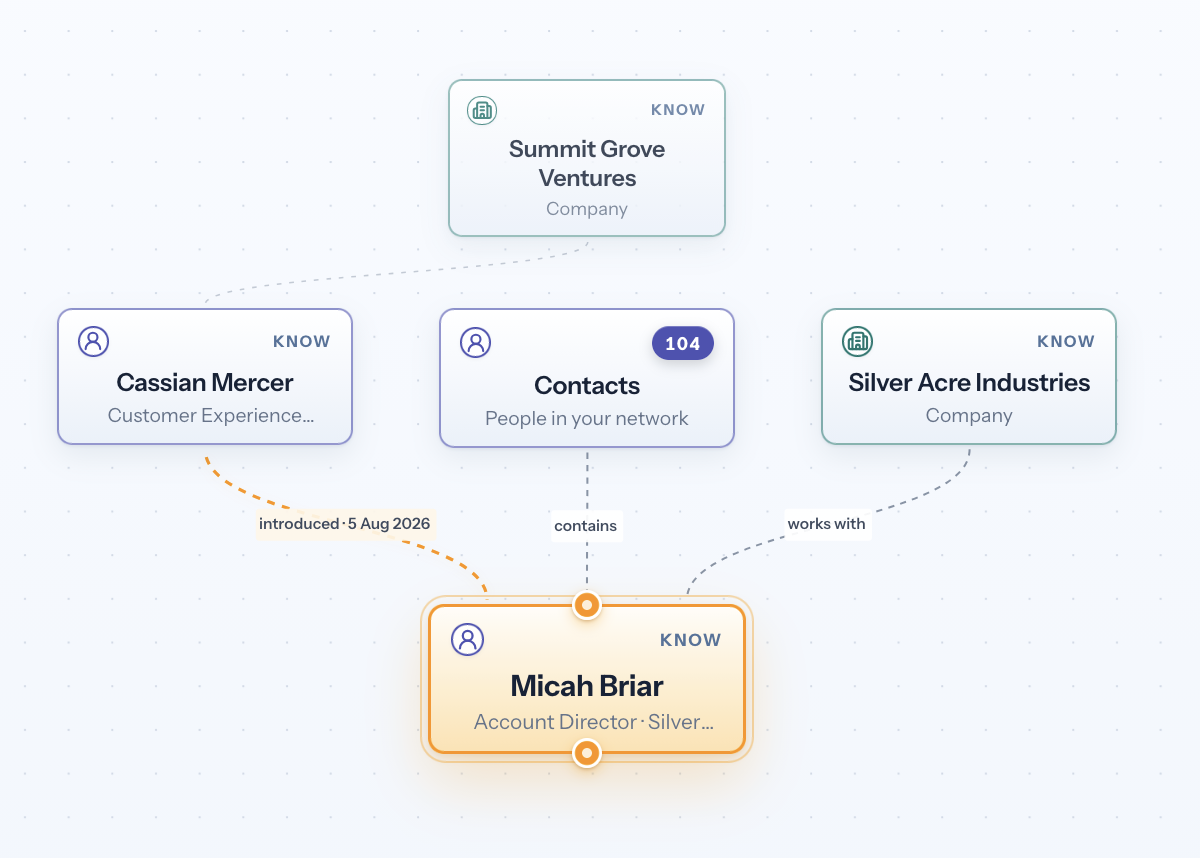
An introduction relationship stays visible in the graph alongside a contact's other connections.
A contact can have other parents, such as a company or group, while one person remains the primary "Introduced by" connection. Kinnetly can also show the shortest saved relationship path between people already on your map. That path records context. It does not prove endorsement or current closeness.
Kinnetly does not read the original email, verify consent, send your reply or update the introducer. You enter or confirm the relationship details yourself. The judgement stays with you.
A warm introduction follow-up checklist
Before you close the record, check:
- Who made the introduction?
- Why did they think you should meet?
- What did each person agree to?
- Did your first reply keep that purpose intact?
- What is the direct next step, if any?
- Who owns each promise?
- Did you send the introducer a brief update?
- Is the original relationship path saved?
Keep the person, purpose and path behind each warm introduction visible. Then follow through on the next step you actually agreed.
Start a private relationship map in Kinnetly.