 Kinnetly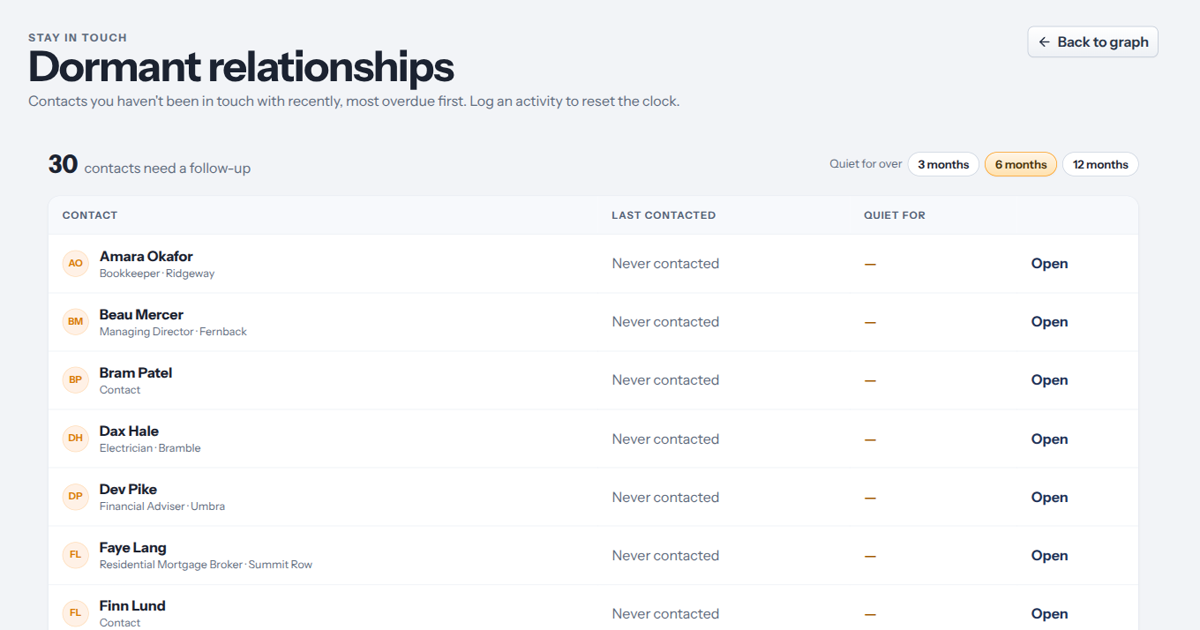
A relationship rarely ends in one clear moment. More often, it fades.
You meant to reply. You meant to check in. You meant to say congratulations when you saw the announcement. Then a week became a month, and a month became a year.
Nobody chose to drop the relationship. It just slipped out of view.
For founders, consultants, salespeople, job seekers, investors, and anyone else whose work depends on trust, that is a real cost. The difficult part is that you usually cannot see it. You do not get a notification when someone stops thinking of you.
The quiet loss is the problem
A missed meeting is obvious. A late invoice is obvious. A cold relationship is not.
You do not see the introduction that never happened because you were no longer top of mind. You do not see the client who asked someone else. You do not see the role that was filled through a warm connection you had let fade.
That makes the problem easy to ignore. Your contact list keeps growing, so it feels like your network is growing too. But a long list of names is not the same as an active network.
A useful network has context, trust, and recent touchpoints. Without those, it becomes a drawer full of old business cards.
Trying harder does not work for long
The usual response is to promise yourself you will be better.
You set aside Friday afternoon for follow-ups. You make a list. You send a few messages. For a week or two, it works.
Then work gets busy again.
This is not a character flaw. Remembering hundreds of loose relationships is too much for one brain, especially when none of them is urgent today. The people who stay in touch well are not necessarily more disciplined. They have a system that does the remembering for them.
You already do this in other parts of life. You do not rely on memory for bills, flights, or birthdays. Relationships deserve the same respect.
Most contact tools are not built for relationships
You probably already have plenty of places where contacts live. That does not mean you have a relationship system.
- Your phone contacts store names and numbers, but not the story behind the person.
- LinkedIn is useful for public profiles and updates, but it is not your private memory of who introduced whom and what happened next.
- A company CRM tracks pipeline for the business. It usually belongs to your employer, not to you.
- A spreadsheet can work for a while, until updating it becomes the thing you avoid.
The missing piece is context. Who introduced you? Where did you meet? When did you last speak? What should you remember before the next message?
Without that, every follow-up starts cold.
The real culprit is capture friction
This is where most personal systems break.
It is not that you do not care about people. It is that recording the useful details takes effort at exactly the moment you are least likely to do it.
You come back from a meeting and tell yourself you will add notes later. You scan a business card and leave it in a pile. You meet someone at an event and remember their face, but not the spelling of their name. A week later, the details are fuzzy.
Once the data is missing, the system becomes less useful. Because it is less useful, you use it less. Then it becomes another abandoned tool.
A relationship system has to make capture easy. If it does not, follow-up will fail later.
What a better system keeps track of
You do not need to record everything. You need to record the details that make the next touchpoint easier.
At minimum, keep:
- who the person is
- how you met them
- who introduced you, if anyone did
- what you last talked about
- how often you want to stay in touch
- any obvious next step
That turns follow-up from a vague chore into a specific action.
Instead of thinking, "I should network more," you see: "I have not spoken to Priya in four months. Last time, she was hiring her first operations lead. I should ask how that went."
That message is easy to send because the context is already there.
How Kinnetly helps
Kinnetly is built around that idea: your network is a set of relationships, not a flat list.
It maps the people you know and how you met them, records introductions, keeps the context behind each relationship, and reminds you before important people disappear from view. The map is private to you, so it can hold the details that would never belong on a public profile.
You can see how Kinnetly works, or browse common ways people use it. If you want a simple routine first, start with our guide to keeping in touch with your network, or use the free keep-in-touch cadence calculator.
Start before the relationship feels awkward
You do not need to revive your whole network at once.
Pick five people you have been meaning to contact. Write down how you know them, what you last discussed, and why you value the relationship. Then send one useful or genuine message.
Do that regularly and your network stops depending on memory. It becomes something you tend.
Ready to stop letting good relationships fade? Get started with Kinnetly for free.