 Kinnetly
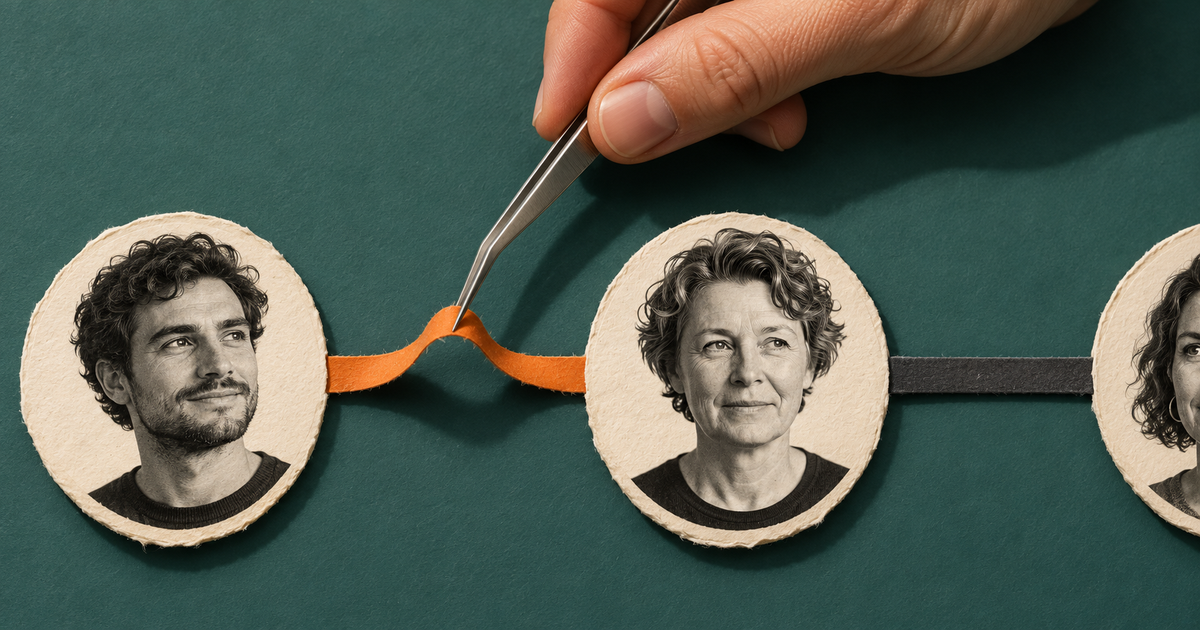
If your relationship map shows the wrong introducer or an old company as current, the safest fix is usually smaller than deleting a contact. To remove a relationship link without deleting the contact, first work out what is actually wrong with the line.
A true connection may need a different primary origin. A past company or group may need to be marked former. A link that never existed should be forgotten. Deleting the person is a separate, much larger decision.
Start with the link, not the person
Open the person's details and look under Links. Read both ends of the connection and its label before changing anything.
Ask one plain question: what fact does this line claim?
A line to a person may record who introduced you. A line to a company or group may record a current or former membership. A line to an event may preserve where you first met. Two people connected to the same event are not automatically connected to each other.
Once you know which fact is wrong, the right action is easier to choose.
| What is true in the real world? | Action in Kinnetly | What remains |
|---|---|---|
| The connection is true, but another origin should be shown first | Change the primary connection | Both links remain |
| The company or group tie was true, but has ended | Mark former, with an optional date left | The historical link remains |
| The recorded link never existed or points to the wrong record | Forget this link | Both records and their other data remain |
| The entire person record should be removed | Delete the person after checking the consequences | The person and their attached data are removed |
Change the primary connection when both links are true
Suppose Sam introduced you to Noor, but your map shows an event as Noor's main origin. If both connections are accurate, deleting one would throw away useful history.
When Kinnetly offers Change on the origin card, you can choose another recorded incoming connection as the primary one. This changes which link is treated as primary. It does not remove either link or create a new relationship.
The choices may include a person, company, group or event. Pick the one that answers the origin question accurately. A person who introduced you and a place where you first met are different facts, even when both belong in the record.
The option appears only when there are suitable recorded alternatives. If Change is not offered, don't invent a second connection to make the control appear.
Mark a company or group as former when the history is true
An old workplace can become misleading if it still looks current. Removing the link entirely may be just as misleading because the shared company explains part of the relationship.
For a user-created company or group link, Mark former keeps the connection while changing its status. You can add a date left when you know it. Mark current reverses that status later and clears the end date.
Use this for a real membership that ended. It is not the right action for a person-to-person introduction. An introduction is relationship provenance, not an employment-style status.
The distinction matters when one person has moved through several roles. The guide to keeping relationship context across several roles shows why current and historical connections deserve separate treatment.
Forget a link when the line itself is false
Use Forget this link when the recorded connection should not be there at all. Perhaps you linked the wrong Alex, chose the wrong event, or recorded an introduction that did not happen.
Kinnetly asks you to confirm the two records involved, then removes that selected relationship. The two records stay on your map. Their notes, activities, reminders and other links stay too.
What disappears is the information held by that edge, including its label, primary setting and any introduction or first-contact date attached to it.
There is no verified one-click undo for an individual forgotten link. Pause at the confirmation and check both ends. If you remove the wrong one, recreate the accurate connection deliberately rather than assuming the old edge can be restored.
Some structural links involving Kinnetly's root or category nodes cannot be forgotten. That safeguard is different from an ordinary relationship link between records you created.
In graph terms, a relationship and the records at its endpoints are separate things. Neo4j's documentation gives a general example of deleting relationships while leaving their endpoint nodes in place. That example helps explain the model, but it does not describe Kinnetly's storage system. Kinnetly's own control determines what happens in Kinnetly.
Check the origin and path after removing a link
If the forgotten link was the displayed origin, look at the person's origin card again.
Kinnetly may display another recorded incoming connection when no primary link remains, but deleting the old primary does not automatically mark a replacement as primary. If another true connection should become the main origin and Change is available, select it deliberately.
Then check How you're connected. Kinnetly calculates the shortest chain through the real links that remain. Another route may still connect the people, or the old route may disappear. Either result can be correct.
Read the remaining path literally. A shared company, group or event is recorded context. It does not prove that everyone on that path knows one another or has agreed to an introduction. The guide to reading a crowded relationship graph one hop at a time can help when several possible routes remain.
Delete the person only when the whole record should go
Deleting a contact is not a shortcut for correcting one line. It removes the selected person record and the links and history attached to that record. Archive hides a person from the active graph while retaining their record. Neither action is a substitute for fixing one false edge.
Before deleting, review the person's notes, activities, reminders and relationships. The article on what goes with a deleted contact covers that larger decision in detail.
For a wrong line, keep the correction proportional. Change the primary connection when the alternatives are true. Mark a real company or group tie as former when it has ended. Forget the link when it never belonged there. Delete only when you intend to remove the person and their attached history.
A quick correction check
Before you confirm anything, ask:
- Are both records the right people, companies, groups or events?
- Did the connection happen, or is the whole line false?
- If it happened, is it current, former or simply the wrong main origin?
- Will removing it affect the origin or connection path you expect to see?
- Am I correcting one fact, or do I truly mean to remove the whole record?
A relationship map is useful when its lines describe what you actually know. It does not need to preserve a mistake, and correcting one mistake should not cost you the rest of a real person's context.
Review one connection in your private Kinnetly map and correct the link before deleting the person.